Notes · 30 September 2026
A lender's website is not government disclosure
When only the lender documents a road, the facts are public but nobody in government has answered for them.
A road project can be fully documented and still have nobody in government answerable for it. Take an illustrative case: the fullest record sits on the lender's website, in an appraisal, a procurement plan and progress updates, while the government's own page gives a title and a status.
It is tempting to call this project transparent. The information exists and anyone can read it. But ask whom each page answers to. The lender's page answers to the lender's own disclosure rules. A resident cannot use it to question a ministry, because the ministry never said any of it. No public official has put their name to a statement they can be asked about.
So two claims are being mixed. One is that the facts are public. The other is that the owner has answered for them. A funder's disclosure can prove the first. It is evidence from a third party, strong on facts and silent on who is accountable.
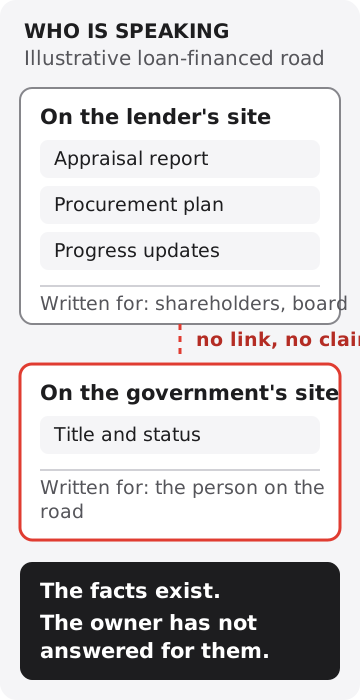
The mix-up has a cost in assessment. If an assessment counts lender pages as government disclosure, it confuses the source of the finance with the government's disclosure practice: a loan-financed project can look open because a lender published, whatever the owner did. It also hides whether the owner has made the same facts answerable under its own name.
The fix starts with bookkeeping. Record who published each document separately from who is responsible for the project. Credit a funder's page as proof that the facts exist, and mark the owner's own disclosure as missing. Then put one question to the owner: which of these documents will you publish under your own name?
The documents already exist, so the answer can be a link and a sentence rather than a new programme. It is a cheap request with a real consequence: someone in government becomes the person you can ask.