A name is a door, not an answer
A public registry gives you a clean record with a company's name on it. It does not tell you who is behind it. A company name is not an owner. It is a door. Ownership transparency begins when the company name stops being treated as the answer.
One disclosure before the story starts: the company network below is fictional; the data model and the tests are real. Mirembe Infrastructure Ltd, Lakefront Holdings Ltd, Blue Gate Nominees Ltd, Riverbank Works Ltd, and Amina K. were invented to teach the Beneficial Ownership Data Standard (BODS v0.4), published by Open Ownership. The standard facts come from the published BODS documentation. The illustration shows why following the line matters; it is not a real case.
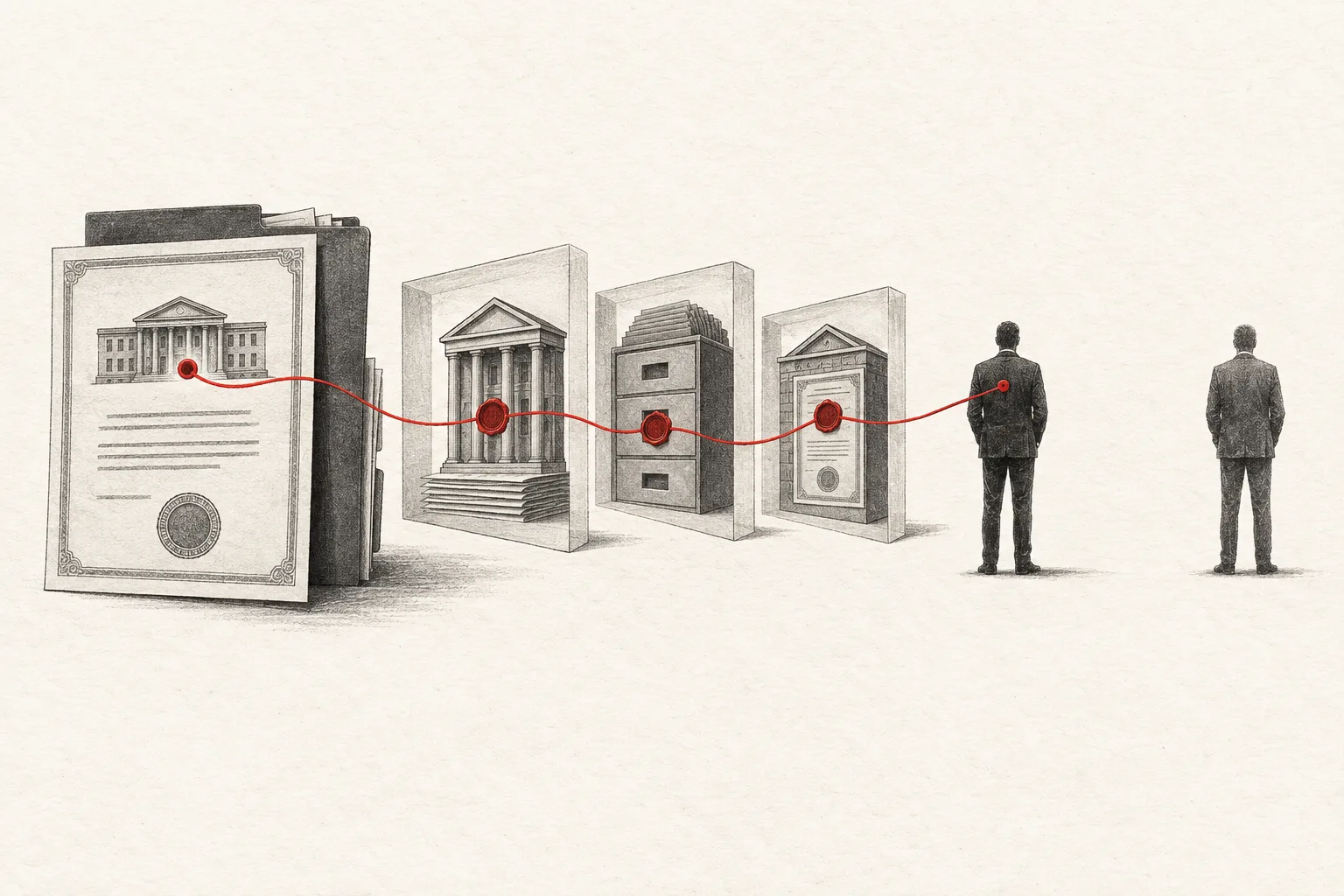
The consequence is practical: a name on a certificate can send an oversight team toward a useful question, but only a dated, sourced chain can show what the record actually declares.
- Claim: the record declares a route from Mirembe through Lakefront and Blue Gate toward Amina K.
- Evidence: the relationship statements, identifiers, interests and dates described below are the inspectable trail; they are a declaration, not truth by themselves.
- Unresolved: whether that Amina K. is the committee member remains open until an authoritative shared identifier or matching attributes corroborate the identity. A conflict flag is a reason to examine the record, not guilt.
Mirembe Infrastructure Ltd has won a public contract: a road, a clinic, a classroom block. Here is why the name on the certificate is not enough. One member of the committee that awarded the contract is named Amina K. If the person who benefits from Mirembe is also that Amina K., it is a conflict of interest worth knowing about.
Pull the line, and it leaves the certificate
The first answer is another company: Lakefront Holdings Ltd, a 60 percent shareholder. Useful, but not enough, because a company cannot ultimately enjoy private benefit or hold a conflict of interest. Ownership is not a list. It is a route. Lakefront leads to Blue Gate Nominees, a nominee arrangement, which leads toward a person.
Direct ownership is a straight line. Indirect ownership is a route that can pass through companies, nominees and legal arrangements before it reaches whoever benefits or controls. Following that route is the whole method.
A name is not an identity
Suppose the route ends at a person recorded as Amina K. That is the moment to slow down. Two things are now in front of you, and they are not the same thing.
The first is what the ownership record declares: a person named Amina K. holds, through Blue Gate and Lakefront, an indirect interest in Mirembe. That is a dated claim by a named source, and it can be tested.
The second is whether that Amina K. is the same person who sat on the award committee. A name alone cannot establish that. Names repeat, transliterate differently, and appear in more than one register for different people. Matching on a name produces false matches and missed matches at the same time. To assert that two records describe one person you need corroboration the name cannot supply: a shared person identifier, or matching attributes from an authoritative source, each with its date.
So the honest end of the fictional trace is a question, not a finding. The ownership record raises it; only corroboration would settle it. Where the corroboration is missing, the correct output is "unresolved", not a name on a slide. And even a confirmed match would establish a conflict of interest worth examining, never guilt.
What the standard actually records
BODS turns that chase into three kinds of statement, each carrying a source and a date. Learn the plain ideas first, then the field names.
- An entity statement records the legal thing: a company, trust or other arrangement. In the example, Mirembe, Lakefront, Blue Gate and Riverbank.
- A person statement records the natural human being who may own, control or benefit. In the example, Amina K.
- A relationship statement is the hinge. It names a subject and an interested party, then lists the interests between them, each with its type, its share, and whether it is direct or indirect. When ownership is indirect, the primary relationship still names the beneficial owner, and the intermediary hops are kept as component records.
In the standard's own field names, a statement carries `recordType` (entity, person or relationship), `recordDetails` with the specifics, and an `identifiers` array. Each relationship interest carries a `type`, a `directOrIndirect` setting, and a `share` modelled as an object, which can be an exact value or a minimum and maximum.
A claim is not a fact. A dated, sourced claim is something you can test. That is the refrain: Name it. Link it. Date it. Test it.
Why the record persists
Statements are never edited in place. A correction is a new statement that amends or confirms the old one. Two identifiers do different jobs: a `statementId` names this claim, and a `recordId` names the thing the claim is about. In the fictional trace, statements from 2023 and 2026 share one `recordId`, so a 60 percent share becoming 20 percent is visible as a change over time, with nothing overwritten.
That persistence matters when a flagged company dissolves and the same person appears behind a new one. Riverbank Works Ltd, in the example's telling, can be replaced overnight. The person record is steadier, because it is keyed to the person rather than the company.
One qualification, because it is easy to overclaim: a person record persists only as long as the register maintains it. Record identifiers are not permanent cosmic facts. A register can close a record, a jurisdiction can stop publishing, and an identifier can be retired. The advantage is relative and institutional, not absolute. What a maintained register gives a regulator is the ability to see a pattern and ask the next question. A pattern worth checking is not a verdict on the person.
Four questions, answered from the record
- Who is the beneficial owner? The line runs Mirembe to Lakefront to Blue Gate to a person, reached through relationship statements. A sourced and dated claim, not proof, and subject to the identity question above.
- Is the interest direct or indirect? Indirect, with two intermediary hops held in component records.
- What changed over time? One record, two statements: a 60 percent share in 2023 became 20 percent in 2026, and nothing was overwritten.
- Known, unknown, exempt or not disclosed? Blank is not the same as none. Where no owner is disclosed, the relationship records a reason instead of a person, for example `noBeneficialOwners`, and the line is drawn broken rather than hidden.
- Entity statementIdentify the legal entity in the record.
- RelationshipFollow the recorded ownership or control relationship.
- PersonReach the person connected to the entity.
- Dated claimAttach the relationship and claim to a date and source.
The limits, in one place
BODS can show who was declared as owner or controller, by which source, on which date, through which interest. It cannot prove by itself that the declaration is true, that the person is guilty of anything, that the structure shown is complete, or that the register is current. It cannot establish that two same-named people are one person. The certificate did not lie. It was incomplete.
The company network here is entirely fictional, and any resemblance to real companies or people is coincidental. The award-committee overlap and the dissolve-and-re-form sequence are illustrative stakes, not a real case. A repeated pattern behind one person is a flag to investigate, never a finding of wrongdoing.
A company name is where the record starts. The public-interest question is who the line reaches, and whether the evidence is strong enough to say so.
The data
| Statement or field | What it records | In this example |
|---|---|---|
| recordType: entity | The legal thing: a company, trust or other arrangement | Mirembe, Lakefront, Blue Gate, Riverbank (fictional) |
| recordType: person | The natural human being who may own, control or benefit | Amina K. (fictional) |
| recordType: relationship | The link: a subject, an interestedParty, and a list of interests | Mirembe (subject) and Amina K. (interestedParty) (fictional) |
| interests: type, directOrIndirect, beneficialOwnershipOrControl | Each interest carries its own type, direct-or-indirect setting, and ownership-or-control flag | shareholding, indirect, true (fictional) |
| share (exact, minimum, maximum) | The size of the interest, modelled as an object | exact: 60, later 20 (fictional) |
| statementDate and source | When the claim was made and by whom, under a disclosure rule | 2026-06-14, source.type ["selfDeclaration"] (fictional) |
| statementId and recordId | statementId identifies this claim; recordId identifies the thing the claim is about | two statements share recordId rel-118 (fictional) |
| recordStatus | new, updated or closed; statements are append-only, never edited in place | new in 2023, updated in 2026 (fictional) |
| componentRecords and isComponent | The intermediary hops of an indirect route, referenced from the primary relationship | Amina K. to Blue Gate, Blue Gate to Lakefront, Lakefront to Mirembe (fictional) |
| interestedParty.reason | Absence recorded rather than hidden, for example noBeneficialOwners | The broken line in the fourth question (fictional) |
Evidence register
Sources
- Beneficial Ownership Data Standard (BODS v0.4), published by Open Ownership, is the schema this piece teaches: https://standard.openownership.org/
- Companion essay, the use case: Linking public contracts to beneficial ownership records, joining procurement data to ownership data via a shared identifier: https://cengkuru.com/essays/black-light/
- Method note: the company network is fictional; standard facts were checked against the published BODS v0.4 documentation in June and September 2026. Built as a self-contained page: no framework, no tracking, no third-party scripts.
Start a conversation
If this piece names a decision you own, tell me what you are hoping to achieve and where I could help.
Start an enquiry →